Simple Metallurgy Concepts Every Advanced Sharpener Should Actually Understand
You can recite Cr, Mo, and V percentages like a parrot. That doesn't mean you understand why the blade cuts the way it does. Steel charts are just recipes. A recipe doesn't mean the chef knows how to cook. What actually matters is microstructure. How those carbides sit. How the grain formed during the quench. Two knives with identical chemistry can behave like completely different animals because one maker understands austenitizing and the other is just guessing. Stop memorizing numbers. Start caring about what lives under the surface.
Carbides Are the Real MVPs
Hardness gets all the glory. But your edge isn't one solid block of hard metal. It's a bunch of microscopic rocks floating in a softer iron matrix. Those rocks are carbides. Vanadium carbides stay small and hold their ground. Chromium carbides can grow fat and rip out under pressure. When you sharpen, you aren't just grinding steel. You're shearing carbides or yanking them free. Big carbides mean great wear resistance. They also mean chipping and a toothy edge that doesn't always want to glide. Small carbides give you a refined apex but less abrasion resistance. Know what you're grinding through. It changes everything about how the edge feels and dies.
The Burr Is a Warning, Not a Trophy
People chase the burr like it's a badge of honor. It isn't. A burr is plastically deformed steel that folded over because you used too much pressure or too coarse a stone. It's work-hardened junk metal clinging by a thread. Leave it there and it snaps off. Now you own a microscopically serrated edge that feels sharp but acts dull. The real skill is raising the burr as little as possible and then murdering it immediately. Edge trailing passes. Stropping. Featherlight pressure. Think of the burr as the steel crying uncle. You won the fight. Now clean up the battlefield before you celebrate.
Hardness vs. Toughness Is Not a Debate
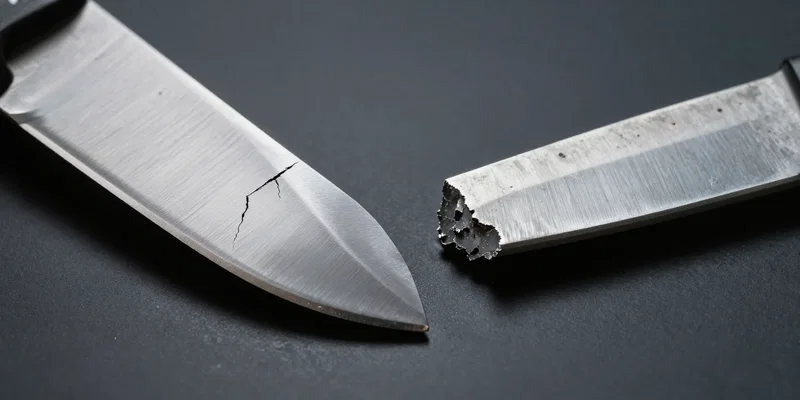
Everyone treats Rockwell numbers like a competition. Harder is not always better. Hardness resists deformation. Toughness resists fracture. You can have both, but physics makes you pay for extremes. Push a steel too high and the martensite turns brittle. The edge holds its shape forever. Then it chips into a sawtooth because it can't handle a sideways load. Softer steel rolls. Harder steel cracks. The magic is the balance and the geometry backing it up. A thin edge at sixty-four HRC is a time bomb. A thick one at fifty-eight might roll cutting a pepper. Context wins. The steel doesn't live in a vacuum.
Grain Size Controls Your Destiny
Here's something nobody mentions at knife shows. Grain size. Coarse grains look like gravel under a scope. Fine grains look like packed sand. Fine grains give you strength and toughness. Coarse grains let the edge fracture along grain boundaries like a chocolate bar. Overheating during forging or sloppy heat treat grows grains. You cannot fix that with sharpening. The edge will always be weak where it matters. Good sharpeners learn to feel when steel is refined versus gross. That gritty, unpredictable feedback on certain stones? Sometimes it's the steel itself. Not your technique.